

Four collective showcases of global fashion at Milan Fashion Week: Keqiao, the Oriental Fashion Show, Brazilian Sustainable Fashion, and B Iconic

Published
September 28, 2026
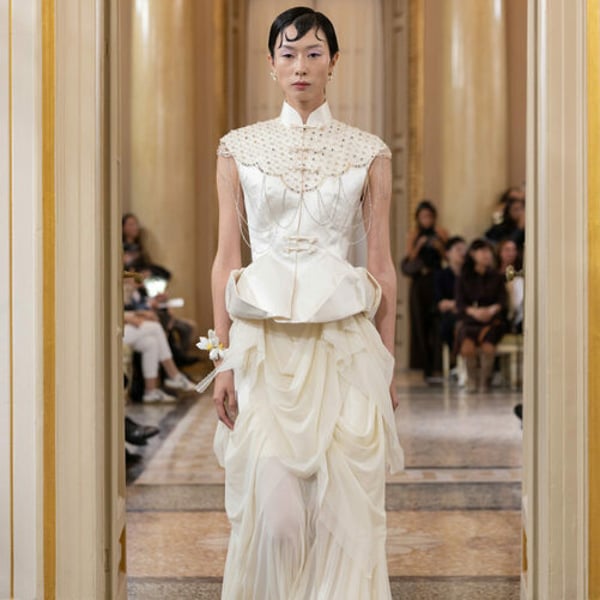
At Milan Fashion Week, four internationally focused projects brought to Milan a renewed global showcase of Chinese, North African–Middle Eastern, Brazilian, and Sino–Korean fashion: the Keqiao Collective Runway Show, the Oriental Fashion Show, Brazilian Sustainable Fashion, and B Iconic.
Keqiao Collective Runway Show
Featured on the official Milan Fashion Week calendar, the third edition of the Keqiao Runway Show spotlighted a collaborative model uniting design, industry and culture which, thanks to a three-year agreement with the National Chamber of Italian Fashion, strengthens exchange between Italy and China.

The project explores the dialogue between two countries that have built part of their cultural and manufacturing identity around fashion and textiles: Italy, with its creative, sartorial, and manufacturing traditions, and China, with a centuries-old textile culture and an industrial capacity now increasingly oriented towards research and creativity.
The initiative is part of the three-year agreement between Keqiao and the National Chamber of Italian Fashion, which sets out a programme of collaboration and exchange that will continue in China. Following the presence of Keqiao talents in Milan, Keqiao Fashion Week will feature a selection of emerging Italian designers, reinforcing the project’s two-way dimension. Keqiao, a district of the city of Shaoxing in Zhejiang province, is one of China’s major textile hubs and, in recent years, has complemented its industrial vocation with a growing focus on creativity, innovation and sustainability.

The brands Gu Yuandai, Liu Hongchao, Sancailiyi, and Sayaanno took centre stage at the presentation for the Spring–Summer 2027 season. Gu Yuandai’s work centres on the relationship between past and future and on reviving craftsmanship in the age of industrialisation, viewing the garment as an object capable of preserving memory and time; Liu Hongchao, through research focused on knitwear, explores the artistic potential of fibres and materials, combining natural fabrics, recycled materials, and traditional Chinese craft techniques; Sancailiyi draws on Eastern philosophy to create an essential, timeless womenswear proposition based on the balance between nature, materials, and the body; Sayaanno, meanwhile, investigates the construction and structure of the garment, interpreting the relationship between body, time and nature by transforming clothing into a silent narrative.

The Keqiao district project also took centre stage at White, the research-driven fashion fair, which, as usual, took place in Via Tortona. An official delegation from Keqiao, led by Jing Yao, District Mayor of the People’s Government of Keqiao District (Shaoxing), met with leading figures from Italy’s institutional and fashion spheres, including Cavaliere Mario Boselli, president of the Italy China Foundation; Brenda Bellei, CEO of White Milano; Maira Cacucci, councillor for the Lombardy Region; Maura Basili, president of Camera Buyer Italia; and Marco Griguolo, delegate councillor for Infrastructure at the Metropolitan City of Milan, to celebrate the evolution of a synergy that goes far beyond textile production alone. Keqiao, a leading industrial hub in Zhejiang, continues to choose Milan as its international platform to showcase its stylistic transformation, through a strategic cooperation that connects two extraordinary manufacturing and cultural heritages.

Fifteen brands took centre stage at this year’s White: Alberto Zambelli, Angelo, Bensen, Davii Poet, Gu Yuandai, Massimo Foroni, Mastrovito, Oliva, Puremono, Ravlvmono, Liu Hongchao, Sancailiyi, Sayaanno, Tayunguan, and Yinan Group.

Oriental Fashion Show
Set against the backdrop of the Leonardo da Vinci National Museum of Science and Technology, three leading figures in contemporary couture with links to the Silk Road tradition took to the catwalk during Milan Fashion Week at the Oriental Fashion Show, founded by Hind Joudar: Yoland from the Sultanate of Oman, Rena from Morocco, and Gowher Gouvernet from Turkmenistan.

For over 20 years, the Oriental Fashion Show has been an international platform dedicated to promoting Oriental couture and fostering dialogue between cultures through fashion. Over the course of its activity, it has presented more than 200 designers from 50 countries in major international capitals including Paris, Milan, Marrakech, Tangier, Dubai, Baku, and Istanbul.
The Omani designer Yoland, founder of her own fashion house, brought a collection of Haute Couture abayas to Milan, dedicated to a contemporary reinterpretation of one of the iconic garments of women’s traditions in the Gulf and the Middle East. The collection draws inspiration from Omani culture and, in particular, from the artisanal heritage of Dhofar, a region renowned for its handcraft traditions, its incense heritage and the richness of its ornamental motifs. Embroidery, sartorial details and artisanal techniques are reinterpreted by Yoland through a contemporary lens, creating a dialogue between tradition, modernity, and cultural identity.

A contemporary fashion brand rooted in Moroccan heritage and craftsmanship, born in the workshops of Casablanca, Rena takes its name from ‘Renata’, the maison de couture run by the founder’s mother for the past 40 years, whilst also evoking the concepts of Rebirth, Renaissance, and Reconnection. Its first collection offers a contemporary reinterpretation of the Moroccan caftan through a modern, versatile and personal approach, halfway between fashion and jewellery. Each garment is individually conceived in Casablanca and crafted by a single ‘maalem’, a master artisan and guardian of Morocco’s traditional savoir-faire.
Gowher Pirkulyyeva Gouvernet is the Turkmen designer and founder of the eponymous maison, who lives and works between Paris and Ashgabat. Trained in Fashion Design in Paris and Costume Design in St Petersburg, and with experience in costume and the performing arts, she now teaches at Formamod Paris and collaborates with French and international haute couture houses. In 2022, she founded her own company in Turkmenistan, with the aim of preserving and reinterpreting Turkmen nomadic tradition through a contemporary lens, leading also to a show at Paris Haute Couture Week. Her research combines ‘keshde’, embroidery and traditional ornamentation with rigorous Parisian-style tailoring.

Brazilian Sustainable Fashion
With the project ‘Brazilian Sustainable Fashion in Milan – Craftsmanship and Culture: The New Luxury’, Brazilian fashion also took centre stage at Milan Fashion Week in September 2026, highlighting its ability to transform the country’s creative diversity into fashion, brands and high value-added products, blending innovation and know-how with sustainability and cultural identity, through to contemporary design.

On September 22, the Brazilian presence began with a fashion show hosted in the historic setting of the Chiostri di San Barnaba in Milan, featuring the collections of 10 female-led Brazilian brands selected for their commitment to adopting sustainable practices across their production processes. On September 23 and 24, the event continued with an exclusive showroom designed as a space for Brazilian companies to meet and engage with buyers, distributors, specialist media, and other professionals from the international market, featuring the following companies: Alina Amaral, Ana de Jour, Ateliê Val Valadares, Camila Machado Ateliê, Celeste, Lybethras, Ludimila Heringer, Natural Cotton Color, Proposta Verde, and Villa Dharma.
The initiative was organised by the Brazilian Textile and Clothing Industry Association (Abit), in collaboration with the Brazilian Trade and Investment Promotion Agency (ApexBrasil), through Texbrasil, the Programme for the Internationalisation of the Brazilian Textile and Fashion Industry, and with the support of the Brazilian Association for Sustainable Fashion (Abrimos).

Brazil’s participation in MFW was also conceived in light of the European Union’s new fashion legislation, which is introducing the Digital Product Passport (DPP), designed to strengthen brands’ transparency obligations regarding the environmental, economic, and social impact of products throughout the entire value chain. The system is due to be introduced from 2027–2028 and will apply to brands that sell their products in the European Union. Against this backdrop, the Brazilian sector already features numerous elements aligned with the evolving regulatory framework, notes ApexBrasil, a non-profit organisation that promotes Brazilian exports, supports the internationalisation of companies, and attracts foreign investment to Brazil. The use of certified materials with a reduced environmental impact, the adoption of responsible production practices, and collaboration with artisan communities make it possible to integrate environmental, economic, and social dimensions into the various stages of production. The presence in Milan has therefore taken on strategic significance.
Together with Abest – the Brazilian Association of Fashion Designers – ApexBrasil runs Fashion Label Brasil, a programme for the internationalisation of high value-added Brazilian fashion launched over 17 years ago with the aim of positioning Brazilian fashion in international markets and promoting the image of an innovative, contemporary country. The programme develops strategic activities and trade-promotion initiatives across womenswear, menswear, swimwear, activewear, footwear, accessories, jewellery, and costume jewellery, supporting companies in expanding and consolidating their presence in foreign markets.

In the textile and clothing supply chain, collaboration between ApexBrasil and Abit takes shape through Texbrasil, a programme that, over the past 25 years, has supported around 2,000 brands in entering export markets, generating 11 billion dollars in business. Abit represents an industrial base comprising 25,700 companies, more than 1.34 million workers and an annual turnover of 221 billion reais in 2024. In this context, Italy plays a particularly strategic role. In 2025, it accounted for 16.9 per cent of Brazilian fashion complex exports to the European Union, making it the bloc’s second-largest market after France.
B Iconic
B Iconic concluded its third edition, held at the Officine del Volo during Milan Fashion Week, consolidating its new model as a platform dedicated to business, networking, brand image, and tangible opportunities for brands. Conceived by Giulio Di Sabato, Simone Ruggeri, and Mitch Mihic and produced by Caremoli & Ruggeri, the event marked a significant evolution with the debut of the Pop-up Store & Temporary Showroom in collaboration with Best Showroom, which complemented the presentation of the collections with a commercial dimension featuring buyer meetings, direct sales, and order taking, alongside an opening to retail with presences such as Matteo Sorbellini and the Korean skincare brand Ongju.
Central to the event were its strong international focus and talent scouting, featuring designers such as Kimooncho, Li Yuntao, Drycri, Sul Young Hee, Par.Lune, Ludovica Milano, Golden Rabbit, Pelliot, Met Jeans, and Massimo Sabbadin, further strengthened by the partnership with the Italy China Foundation and the ‘Future Moda’ project, dedicated to dialogue between Italy and China for young talents, under which Li Yuntao was selected by B Iconic and the Foundation.

Significant attention was devoted to the new generation through the B Iconic Emerging Talent Programme presented by Fondazione Fiera Milano, which enabled three talents from Marangoni, IED and IUAD to show at no cost, with professional production and meetings with buyers and the press. The event reaffirmed its interdisciplinary ethos through the dialogue between fashion and art curated by Sofia Curci and through site-specific installations by Eros Gasparini, Jacopo Rumignani, Federico Politanò, and Alex Belli with the collection ‘The Materials’, while reiterating its social commitment with ‘Women for Women Against Violence’, the Official Social Impact Partner, conceived by Donatella Gimigliano and promoted by Consorzio Umanitas, which brought Antonietta Tuccillo to the catwalk and promoted the Camomilla Fashion Award created by master goldsmith Michele Affidato.

As for the accolades, the B Iconic Award went to Kimooncho for her contemporary reinterpretation of Eastern aesthetics and the kimono, crafted entirely by hand by the designer in natural silk with original prints produced in Como. Second place went to Antonietta Tuccillo, who transforms the art of crochet into unique, handmade garments, created as a journey of strength and rebirth whilst undergoing cancer treatment. The B Iconic Emerging Talent Award, presented by Fondazione Fiera Milano, was awarded to Giovanni Alberto Acanfora of Istituto Marangoni for his collection ‘L’Anello Mancante’, created as part of a programme that also involved Sofia Licari of IED and Benedetta Panuccio of Accademia IUAD Milano.

The B Iconic Award for Art was presented to Marzia Ratti, a visual and conceptual artist active since 2001. The B Iconic Award for Excellence in Vision & Leadership was awarded to Maura Basili for her contribution to the development of independent retail and the promotion of ‘Made in Italy’.
The B Iconic Award for Excellence in Couture & Cultural Heritage went to the Korean designer Sul Young Hee for over 40 years of dedication to haute couture, transforming Korean tradition into a contemporary language. The B Iconic Camomilla Fashion Award honoured Maria Elena Viola, Editor-in-Chief of Donna Moderna, for her journalistic commitment to rights, the fight against gender-based violence and women’s health, and Leo Mel, for the courage to defend his sister and family by seeking justice without resorting to violence.
This article is a translation.
Copyright © 2026 FashionNetwork.com All rights reserved.