


Tranoï: Spotlight on French and Thai label selections

Published
October 2, 2026
Behind the columns of the Palais Brongniart, in Paris’s 2nd arrondissement, Tranoï launched its Spring/Summer 2027 season. French, English, Italian, Spanish and even Hindi mingled on Thursday at the opening of this event dedicated to fashion and accessories design.

The Parisian event, featuring a selection of labels, 95 per cent of them international, got off to a strong start this season.
“We’ve seen a 35 per cent jump in visitor pre-registrations compared with the Autumn 2025 edition. And that was evident from Thursday,” Emilie Talec, who is at the helm of the organisation, told FashionNetwork.com.
“In conversations our teams have had with retailers, we’ve sensed a real appetite for new discoveries. And this applies in particular to this season’s jewellery and fine jewellery offer.”
Another major strength is the discovery of new labels, with a significant number of first-time participants. In recent years, the trade fair has cemented its position as a platform for creations from new horizons.
“We have now been working with Canex for nine seasons to promote and support brands from Africa,” explained Talec.
“It took several seasons before buyers began to place their trust in us. But once the quality of the offer and deliveries was there, it lent credibility to our approach. Today, we offer this advice to other collectives in the run-up to trade fairs, as we are doing this year with a selection of Thai brands.”
Indeed, right at the entrance, at the top of a short flight of stairs, the trade fair unveiled its ‘Thai Room’, a space reserved for ten Thai brands specialising in jewellery, accessories and ready-to-wear. FashionNetwork.com met a few of them.

Founded in 2023 and based in Phuket, the brand Balc is reinventing the traditional art of batik by weaving it into an everyday wardrobe. Inspired by the cultures of Thailand and Laos, particularly through its prints, the label showcased a vibrant colour palette. It nods to hues once reserved for the royal family, with emblematic figures and motifs such as the peacock and the dot. In celebrating Thai heritage, the brand offers a range of pieces including trench coats, a current trend in Thailand. With its prints, Balc hopes to appeal to a wide audience — from teenagers to adults and international artists — in Thailand, Singapore, and perhaps soon in France.
Brands exploring Europe
Founded six years ago in Bangkok by a trio of female founders, AOP Archive has set itself the mission of offering women a high-quality wardrobe at accessible prices, ranging from €55 to €100. Proudly ‘Made in Thailand’, the label favours materials suited to the Thai climate and fuss-free, such as polyester, to create well-tailored, easy-to-wear designs. The brand generates 80 per cent of its sales online via Asian platforms such as Lazada and Shopee, and 15 per cent through multi-brand retailers. The founders now plan to expand the brand into various Asian and international markets. This ambition is underscored by the brand’s selection by Tranoï, which is enabling it to venture onto the international stage for the first time.

Just a stone’s throw away, The Parrot is a ready-to-wear brand catering mainly to women. Founded in 2013 in Bangkok by Pimsiri “Ploen” Nakswasdi, the label is already well established in Thailand, with a flagship store, around thirty employees and several concessions. The brand made the trip after noticing interest from European buyers who had travelled to Bangkok to discover its collections. Its “artistic yet understated” range is positioned in the mid- to high-end segment and stands out for its signature pleats and prints created in-house at its own studios.
Le Studio Français and its tricolour stars
In the second room of the exhibition curated by the Tranoï team, a selection of French brands is brought together under the Studio banner. Founded by Thomas Jaspar and Ferdinand Pascal — school friends who previously worked at Y/Project and Saint Laurent respectively, before moving on to Dior — Jaspär reimagines the archetypes of everyday wear. The label, designed by Jaspar, draws on references such as Marithé + François Girbaud to put a new spin on basics, with shirt collars transformed into belts or mittens grafted onto bomber jackets. Made in Paris’s 10th arrondissement using Japanese denim and Asian fabrics, the pieces (€250–€300) target archive aficionados and Parisian artists. Operating via drops of five to eight looks, accompanied by regular pop-ups at Espace Sambré, the duo has recently expanded internationally with a presence at Tranoï Tokyo, and potential distribution to follow in East Asia.

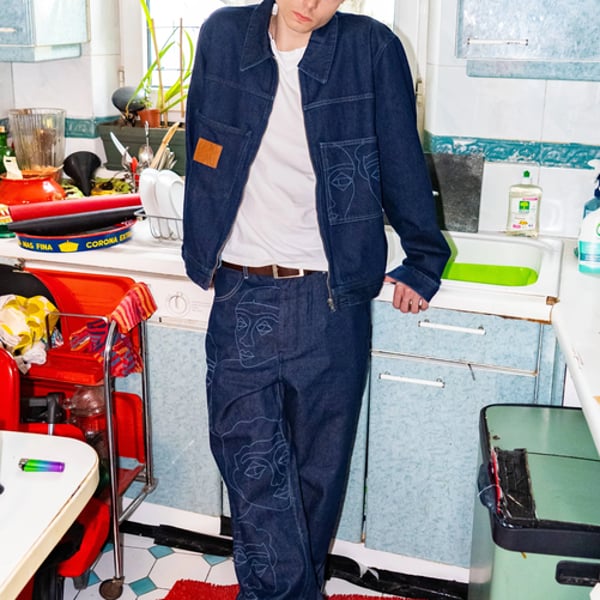
Founded three years ago following a meeting between artist Arthur Chazeau and creative director Thierry Vainqueur (who boasts a career spanning over thirty years at Castelbajac, Saint Laurent and Lacoste), Atelier Chazeau unfolds in a hundred shades of indigo. Each garment becomes a component of a work in motion, featuring narrative murals (“Avec vous”, “La Danse”, “Autrui”) on 290 g canvas, created using laser and handcrafted embroidery. Worn by personalities such as Orelsan and Théo Juice, the pieces are made in Tunisia and sold in boutiques such as Demain Rétro in Paris and Édifice in Japan.
Many visitors from Asia
The racks next door were occupied by Luis Santos Studio and its eponymous designer. Founded less than two years ago by a professional with thirty years’ experience in fashion, the brand offers a unisex, one-size wardrobe made in Portugal. Inspired by Japanese fashion, architecture and aesthetics, it favours enveloping silhouettes designed as protective cocoons. The high-quality fabrics are sourced largely from the Nona Source platform, supporting a responsible production process organised into mid-season drops. Available online and in concept stores in Kyoto, Beijing and Lisbon, the label is particularly popular with Asian shoppers from South Korea, China and Japan.

Finally, Maison Flore, celebrates France’s textile heritage through a 100 per cent upcycled women’s ready-to-wear collection, crafted in Paris by local seamstresses. Founded over five years ago by Flore Mouren, a descendant of a long line of embroiderers, the brand upcycles used linen and garments into one-of-a-kind pieces produced in limited editions, such as a reimagined shirt made from deadstock poplin. Also active in home textiles and, more recently, in accessories, the brand made a name for itself right from its launch with a corner at Le Bon Marché, picked up by the Japanese press, enabling it to generate a significant proportion of its sales in Japan.
Beneath the palace’s arcades, the fair showcases collections from Indian, Uruguayan, Italian and Spanish labels across a variety of themes, with 60 per cent ready-to-wear and 40 per cent accessories.
The show runs until Sunday and will also feature a fashion show by three Chinese brands this Friday at 3 pm, presented by Bonjour Echoes 2026: The Sound of Life, featuring Warrior 1927, Jun by Yangjun and RAXXY.
Copyright © 2026 FashionNetwork.com All rights reserved.