

Men’s fashion: department stores strengthen their flagship brands and nurture the next generation

Published
October 5, 2026
Faced with growing dependence on a handful of mature brands and shifting consumer expectations, members of the International Association of Department Stores (IADS) are undertaking a major overhaul of their menswear departments for the 2025–2026 financial year. Rather than multiplying product lines, retailers are opting to streamline their assortments in order to showcase their long-standing core brands, identify tomorrow’s growth drivers and maximise the profitability of their sales floors.

Over the period in question, menswear remains a stable pillar of the IADS members’ business model: on average, it accounts for 13% of total revenue (ranging from 6% to 21% depending on the group). At the same time, digitalisation continues to advance, with e-commerce now capturing an average of 22% of menswear sales.
Capitalising on the momentum of the premium segment
Beneath this apparent stability in volumes, the very structure of menswear consumption is being radically reshaped. On a like-for-like basis, the contemporary and premium segment is surging, rising from 34% to 43% of sales. Conversely, the high-street and mid-range segments are softening slightly, slipping from 35% to 31%. Entry-level, meanwhile, is dropping sharply, from 12% to 7%. Luxury and accessible luxury, on the other hand, are proving resilient, together accounting for 19% of the assortment.
The menswear bestsellers continue to be dominated by must-have brands: Ralph Lauren, Hugo Boss, and Tommy Hilfiger lead the pack, joined in various regions by Lacoste, Moncler, Emporio Armani, Levi’s, and Brooks Brothers. While these giants guarantee volume, this level of concentration has become a major vulnerability: a slowdown by just one player can destabilise the entire department.
A more tightly curated selection
As a result, department stores have stepped back from proliferating brands, a strategy that diluted both visibility and sales per square metre. The emphasis is now on stronger presentation and storytelling around their key brands.
The Swiss retailer Manor, for example, favours the concession model, impactful visual merchandising and short-lived activations (such as a Boss beachwear pop-up) to create excitement without overloading its brand portfolio.
In the UK, John Lewis is reporting clear gains following the refurbishment of its brand corners and the deployment of dedicated advisers for international labels.

A similar approach is being taken in Mexico by El Palacio de Hierro, where wholesale brand ambassadors are delivering significantly better results than multi-brand sales assistants. The key challenge now is to pinpoint the brands with the potential to scale up. While labels such as Carhartt naturally attract an urban clientele, their selective distribution strategies are curbing large-scale growth.
Accessories perform well in menswear too
To prepare the next wave of bestsellers, department stores are rolling out a three-speed strategy spanning luxury and formalwear (Brioni, Brunello Cucinelli, Tom Ford, and The Row), contemporary and lifestyle (Arket, Filson, A.P.C., and Drôle de Monsieur) and streetwear (Fear of God and its Essentials line). More cutting-edge labels, meanwhile, serve primarily as a marketing lever: Galeries Lafayette, for instance, has given American designer Willy Chavarria a dedicated space and exclusive window at its Boulevard Haussmann flagship, prioritising media impact and footfall over immediate profit.
Accessories and activewear have also been identified as key growth drivers. Retailers agree on one point: a single brand can no longer sustain an entire category. To create a true shopping destination, the offer must be both deep and varied. In leather goods and luggage, category leaders Tumi and Coach are flanked by Sprayground and Rains, while major luxury houses (Gucci, Prada, Bottega Veneta) sit alongside urban labels such as Sandqvist and heritage names including Longchamp, Lancel, and Le Tanneur.
Established brands spanning multiple worlds
In sports, running brand On has emerged as one of the leaders in men’s footwear, while Lululemon is driving activewear. Around them, a highly technical ecosystem is taking shape, bringing together Satisfy Running, District Vision, Arc’teryx, Vuori, and Rhone. Menswear departments are also serving an increasingly diverse clientele. Women account for a large share of menswear purchases, sometimes representing more than half of all transactions. At the same time, a younger female audience is embracing masculine cuts for their own wardrobes, prompting department stores to broaden the size ranges of labels such as Ami Paris and Acne Studios within the menswear areas themselves.

For department stores, attracting younger male customers remains challenging given pressure on disposable income. Faced with a more selective clientele, retailers are innovating: Manor is rotating emerging brands through ultra-connected test spaces, Bloomingdale’s is ramping up its entry-level streetwear offer, and some members are introducing credit facilities or focusing on entry-price categories such as back-to-school and backpacks.
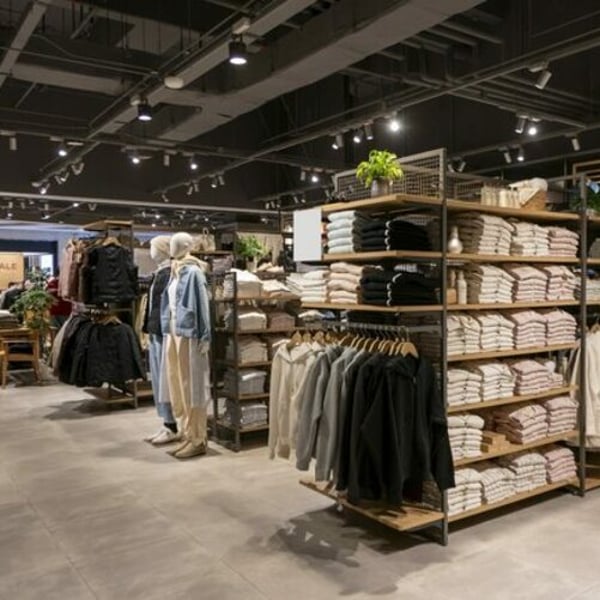
Finally, according to retail research firm Newstores, an IADS partner, the physical layout of stores must adapt to a pragmatic male mindset: men generally know what they are looking for. The task, therefore, is to streamline their journey in order to encourage additional impulse purchases.
Copyright © 2026 FashionNetwork.com All rights reserved.