

Fugazzi: from niche perfumery to conquering the mainstream

Published
September 28, 2026
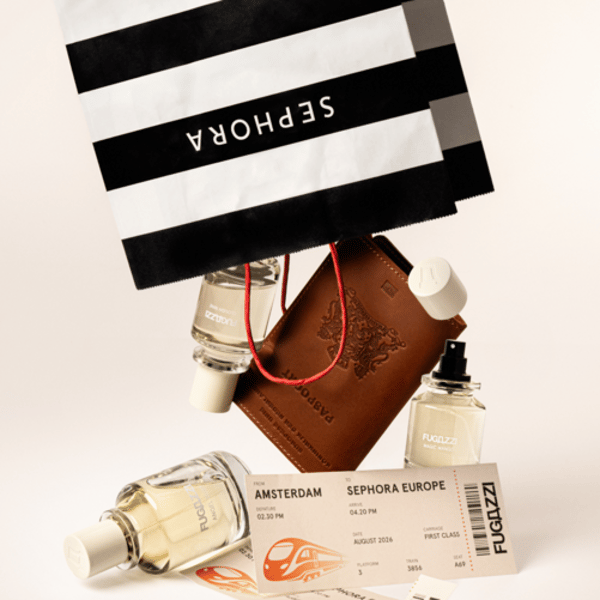
There are perfume houses that advance in measured steps, cultivating rarity and carefully selecting just a handful of stockists for their bottles. And then there is Fugazzi. Founded in Amsterdam in 2018 by Bram Niessink, the young Dutch house has chosen a markedly different course: to scale quickly, enter multiple markets and now rely on Sephora. This move raises a question that has become central for niche brands: how far can you expand distribution without losing what sets you apart?

Already present in the Netherlands, the United States, Germany, Italy, and the United Kingdom, Fugazzi has made internationalisation one of the engines of its growth. France, however, is a more recent market. The house first built its presence there through independent retailers before entering department stores, notably at La Samaritaine in late 2025 and then at Galeries Lafayette, with counters at the Haussmann and Champs-Élysées stores. The move into Sephora marks a new phase in this expansion, and it goes well beyond France, amounting to a roll-out in 18 countries.
This acceleration might seem at odds with the conventions traditionally associated with niche perfumery. “For me, we also need to define the notion of ‘niche’. Often, people limit ‘niche’ to distribution. But being ‘niche’ isn’t only about where you are stocked. I think it is first and foremost about trends, consumers, what we offer and the experience we create. Of course, if we’re literally present in every shop, we need to find the right balance,” explains Margaux Rieutort Cottel.
From this perspective, ‘niche’ is measured by a house’s ability to preserve an identity, a product proposition and an experience that are sufficiently distinctive. It is precisely on this ground that Fugazzi intends to defend its positioning. “Sephora has a marketing strength and an aura which, in my view, really resonate with consumers. They have this ability to generate so much desire amongst consumers whilst also being able to offer this kind of novelty and this kind of universe. To me, they are beauty experts. When you want to be a major player in beauty, it seems logical to work with people who can lead the field.”
‘Playful luxury’

To understand this strategy, you have to return to what defines Fugazzi’s identity. Since its creation, the house has sought to step away from the traditional codes of niche perfumery with an approach it sums up in a single phrase: ‘playful luxury’. It is a way of claiming the premium without necessarily adopting the sector’s most serious or most exclusive codes, and of building a brand associated more with its universe than with its price tag alone.
This ambition is linked to its founder’s background. Bram Niessink does not come from the beauty industry. His entry into perfumery began almost by chance, after a trip to Egypt with his grandfather, an archaeology enthusiast. Back in the Netherlands, he began experimenting with compositions at home, initially as a hobby. His first blends caught the attention of those around him, and one of them became Fugazzi’s first fragrance. Niessink then invested his savings to produce his first bottles, filling them by hand in his father’s garage before personally approaching his first retailers.
This craft origin remains central to the house’s philosophy. “Bram wanted to reflect this idea: good quality, but at a fair price. He didn’t want the brand to be immediately defined by its price, as in: ‘It’s expensive, so it’s luxury.’ He wanted to offer something high-end yet still affordable, so that the brand would be associated more with its cool, modern side than with its price.”
This positioning is reflected directly in the business model. Asked how Fugazzi manages to price below certain competitors in niche perfumery, the brand points to ‘a slightly lower margin’. The house is prepared to reduce its unit margin to maintain a value-for-money proposition it sees as differentiating. Around three-quarters of the collection consists of perfume extracts, with concentrations between 30% and 50%, whilst the recently developed eaux de parfum reach 20%.
France: a particular challenge
France is now a particularly strategic market for Fugazzi, but also a demanding one. After an initial presence with independent retailers and then in department stores, the house is seeking to build what it calls its ‘brand authority’ there, facing consumers who are already familiar with a particularly extensive perfumery offer. “For us, it’s very important to succeed in building this authority, even if it’s a huge challenge. We’re not a French brand in the eyes of French consumers, so it’s extremely complicated. The French aren’t the easiest. But it’s a challenge I quite like: if we were to take it on, it would be to say we’ll be one of the first foreign brands to ‘crack the code’ of the French and really move the needle on the French market.”

The Middle East, for its part, is another strategic market, notably because of its maturity in niche perfumery. According to Fugazzi, some retailers in the region are already more advanced than their European or American counterparts in showcasing niche brands and propositions.
On the business front, Fugazzi does not disclose its turnover but offers some indications of its growth trajectory. Having tripled its turnover the previous year, the house now expects double-digit growth. “We’ve been at triple digits so far, because we tripled our turnover last year. We’re going to drop to double digits.” Direct e-commerce now accounts for around 27% of sales, driven in particular by investments on social platforms. “Bram really saw e-commerce as a marketing tool. We’ve invested heavily in media, on Meta, on TikTok, etc. Once the algorithm kicked in, things really accelerated.”
This development strategy is also continuing in bricks-and-mortar. After opening a first shop in Berlin in June 2024, followed by a second in Tokyo’s Shibuya district, Fugazzi plans a new opening in Mexico City’s Roma district by the autumn.
The launch at Sephora thus appears as a new step in a growth trajectory already well under way. For Fugazzi, ‘niche’ is no longer necessarily synonymous with scarcity in distribution. It can also reside in the way the product is conceived, the brand is built, consumers are understood, and desirability is created. It remains to be seen whether this broader definition of ‘niche’ will allow the house to scale up without losing what forged its identity.
Copyright © 2026 FashionNetwork.com All rights reserved.