
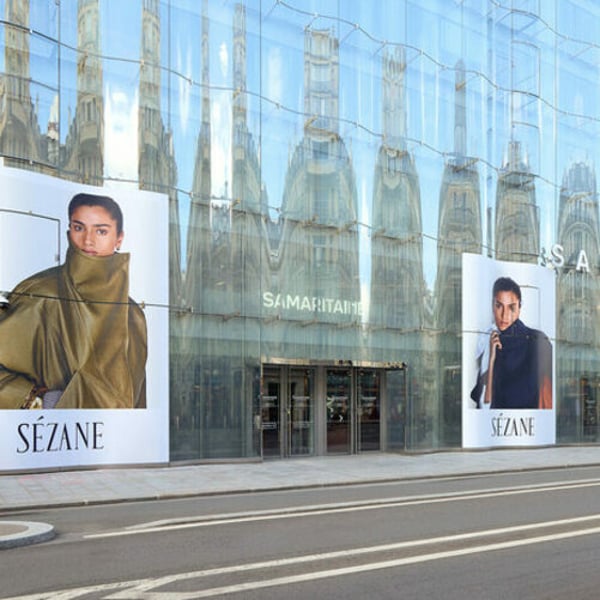
Sézane, Fursac, and Jonak arrive at Paris’ La Samaritaine as its premium overhaul takes shape

Published
September 28, 2026
A year on from its exit from travel-retail specialist DFS, and ahead of integration into the Le Bon Marché organisation in 2025, La Samaritaine’s revamped offer is beginning to take shape. On site, whether strolling through the aisles facing Rue de Rivoli or the floors of the historic building along the Seine, the first strategic choices made by LVMH’s Right Bank department store are immediately apparent as the post-summer season gets under way.

Having unveiled its beauty strategy designed to serve both department stores – notably by curating a niche fragrance offer at La Samaritaine – the commercial team has begun the groundwork on the core of its fashion offer. The ambition is clear: to turn casual visitors into buyers – and, ideally, loyal customers. To that end, the teams have chosen to bring leaders of the accessible-luxury segment onto the historic floors, which were previously much more luxury-oriented.
From the ground floor, the change of tone is immediate. The leather goods selection, until now heavily focused on the major luxury houses, now hosts a large pop-up that shakes up the proposition, with shelves giving pride of place to labels such as DeMellier, Lemaire, Isabel Marant, Soeur, A.P.C., Ganni, Dragon Diffusion, Mlouye, Naghedi, and even the returning Francesco Biasia. In addition, a playful temporary installation by Rimowa, the LVMH group’s luggage brand, takes centre stage in a space previously occupied by the big luxury names. A strong signal, then, from the very threshold of the store.

Climbing the steps of the store’s monumental, emblematic staircase, the commercial shift becomes clear. The historic Pont Neuf building, edging the Seine, is no longer reserved solely for ultra-luxury, and the modern building designed by SANAA has taken on a tone more geared towards premium sport and outdoor, while still featuring a substantial Arc’teryx area, a selection from Canada Goose and Parajumpers, as well as a few contemporary lines connected to the urban scene.

In the historic building, in the womenswear department on the first floor, Sézane’s installation reads like a statement of intent. The retailer’s teams have a close relationship with Morgane Sézalory’s brand. Already a major success at Le Bon Marché, it has just opened a pop-up opposite the Left Bank store to showcase its new approach and an even more culture- and lifestyle-led tone. At La Samaritaine, the brand is now establishing its universe in a second major Parisian department store and taking over an imposing space, directly occupying the spot previously held by emblematic designer labels such as Jacquemus, Acne Studios, and JW Anderson, which have been redeployed to large adjacent corners.
Customer flow has been completely reshaped: clearly, the arrival of this heavyweight of French ready-to-wear is driving an immediate surge in footfall at the heart of the historic building, from international visitors to French – particularly Parisian – clientele.

The same holds in the menswear department. A north alcove has been completely reconfigured around a highly commercial menswear hub bringing together Fursac, Boss, Octobre Éditions, and Sandro. Around the central atrium, the premium offer is displayed on rails with Bompard, Officine Générale and the Italian brand Herno available exclusively. This reshuffle has seen designer labels move to the southern side: Marni and Maison Margiela, formerly confined to the Rivoli building, now share space directly within the Art Nouveau structure. The result is new dialogues between the various designer offers.

In footwear, a walk through the department confirms the strategy. Jonak’s large-format presence alongside Bobbies embodies the floor’s drive for accessibility. With stronger brand universes, the more affordable offer is not simply tucked away at the back: it is staged to catch the eye.

For the teams at La Samaritaine, this clearly marks a first phase of spatial and merchandising reorganisation, following the failure of the concept launched by DFS in 2021. While turning the business around is a stated objective, this first season with a more accessible offer is shaping the site’s new identity. The key challenge for the 20,000-square-metre space is now to attract visitors and shoppers and to make its new offer known: a reimagined balance between luxury’s international pull and the hoped-for profitability of accessible premium.
Copyright © 2026 FashionNetwork.com All rights reserved.