




War hits Ukraine’s bid to stop the ‘amber mafia’

By
AFP
Published
September 29, 2026
Illegal amber mining has blighted the landscape in Rivne, northwest Ukraine, leaving just tree stumps, small bushes and swampy puddles deep in the coniferous forest. Mafia-style groups flushed out chunks of the golden fossilised resin for years, paying little regard to the environment, fuelling a black-market industry that devastated thousands of hectares.

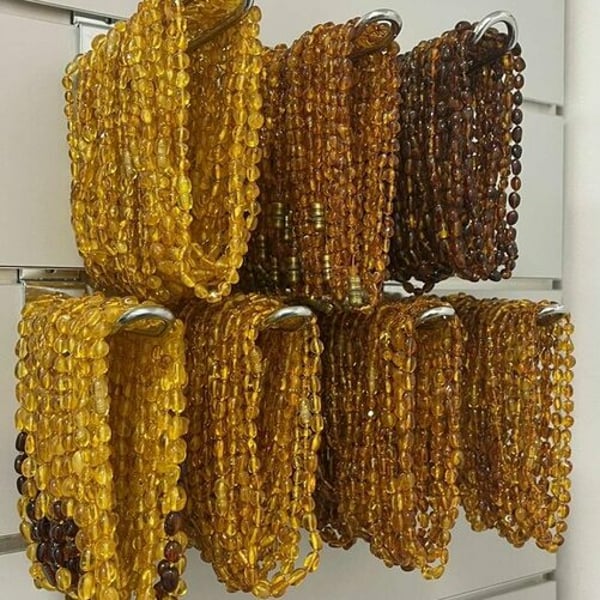
Amber is used to make jewellery and other products, which are hugely sought after in China. Ukraine started regulating the industry just a few years before Russia’s full-scale invasion in February 2022. But stretched for resources during a war that has become the biggest in Europe since World War II, industry figures now warn that fragile progress in cleaning up the lucrative sector is being wasted.
Unregistered – so-called “grey” – amber is flooding the market, environmental inspections have been suspended and firms are relying on private security groups, armed with weapons siphoned from the front, to protect their sites. “There are many dishonest operators, a very, very large percentage of dishonest subsoil users,” Oleg Bogelsky, co-owner of Ukraine’s Amber Galbin group, a mining company with operations in Rivne, told AFP. He estimated about 60% to 70% of all amber being mined in Ukraine is “grey.”
“Real chaos”
Ukraine has some of the world’s biggest reserves of amber, the deep golden resin known as the “sun stone.” After the Soviet Union collapsed in the 1990s, rogue operators swooped to cash in on surging Chinese demand.
Large-scale miners controlled by criminal groups devastated the countryside as they flushed out huge quantities of amber using motor pumps, becoming known as the “amber mafia.” There was little in the way of legislation, regulation or enforcement to stop them. It was “real chaos” that led to an ecological “catastrophe,” said Olena Belichenko, an expert at the International Amber Association.
“Mining was carried out illegally, the environment was effectively suffering, and our resources were being plundered for 30 years,” said Bogelsky.
2,000 illegal miners
Andriy Lototsky, director of the Sonyachne Remeslo mining company, is matter-of-fact about how he got involved in the industry. “Like everyone else, illegally,” he told AFP. “No one paid attention to plants or trees. Everything in their path was just knocked down.”
Ivan Shvyryd of Volodymyrets Forestry, a government forest protection agency, recalled turning up at one illegal extraction site with a handful of police, to find “2,000 people digging.”
“When a fifth-grade child doesn’t go to school and goes to dig for amber instead… isn’t that a shame?”
Ukraine in 2019 passed a long-awaited law regulating amber mining, mandating less intrusive practices and excavator-digging based on approved plans. Permits were issued mainly for areas heavily damaged by the illegal mining, with private businesses then forced to put the land back into proper condition.
Official amber extraction and exports steadily grew. On-the-book exports of unprocessed amber rose from 0.61 tonnes in 2020 to 88.83 tonnes in 2025, according to data from Ukraine’s Customs Service obtained by AFP.
But martial law, imposed in 2022 when Russia invaded, suspended scheduled inspections and environmental audits, leaving regulators little insight into what is happening on the ground. “Some subsoil users abuse their position and, perhaps, some extract illegally,” Mykola Kotniuk, chairman of the Amber Business Association of Ukraine, conceded. He said groups that only have permits for pilot and exploratory work may be extracting.
Competitive edge
Cases of flagrantly illegal pumping are still “isolated,” said Lototsky. Ukraine has opened 369 probes into illicit amber mining and possession since 2024, the head of the Specialized Environmental Prosecutor’s Office Borys Indychenko told AFP.
They include a mining ring uncovered in June 2026, led by a local official, accused of causing some $8 million in environmental damage. According to a report by Intelligence Online, companies are bringing in private security contractors armed with black-market weapons stolen from the front line to protect their sites from being ransacked.
“Enterprises set up fences and checkpoints, and in some cases, bring in security guards who may be part of an organised criminal group,” prosecutor Indychenko said. Legitimate players are calling on the state to resume inspections and put the industry on a tighter leash – saying those who bend the rules are at a competitive advantage.
“If we now sit down together with honest subsoil users and the state and adjust the vectors a bit, change direction a little… then of course we will become number one in the world,” said Bogelsky.
Copyright © 2026 AFP. All rights reserved. All information displayed in this section (dispatches, photographs, logos) are protected by intellectual property rights owned by Agence France-Presse. As a consequence you may not copy, reproduce, modify, transmit, publish, display or in any way commercially exploit any of the contents of this section without the prior written consent of Agence France-Presses.