
Seen at Milan Fashion Week: Agnona, Saman Loira, Sara Behbud, Pianegonda, and Rossano

Published
October 1, 2026
Milan Fashion Week 2026 has drawn to a close, with proposals spanning sophisticated, sensual, and mature looks, the widespread return of skirts, modern reinterpretations of heritage codes, and a search for a new sensuality. The week stretched from the spectacular opening show by Vogue World – complete with drones flying over the Galleria Vittorio Emanuele – to the finale by Giorgio Armani, showcasing the brand’s customary, timeless elegance from the Piacenza-born designer, who passed away a year ago.
And as always, Milan Fashion Week brought with it a wealth of creative and distinctive events and presentations, both on and off the official calendar, from adjacent fashion labels, experimental research brands and young, up-and-coming names. FashionNetwork.com had the opportunity to admire five of these original projects.
Agnona: 2025 closes on a high note; the SS 2027 collection draws inspiration from open-ended journeys
“Coast to Coast” is the name of Agnona’s Spring–Summer 2027 collection, dedicated to travel. “It’s a journey with no fixed destination, from coast to coast, but we don’t know which country, nor where, how or when it happens. Still, one must always try to travel – with one’s mind, one’s heart, one’s desires – and never stop, given that the world, when you open the newspapers, seems to want to immobilise you every day,” says Stefano Aimone, CEO and creative director of the quiet-luxury women’s and men’s ready-to-wear brand, revitalised in recent years by the Aimone family.

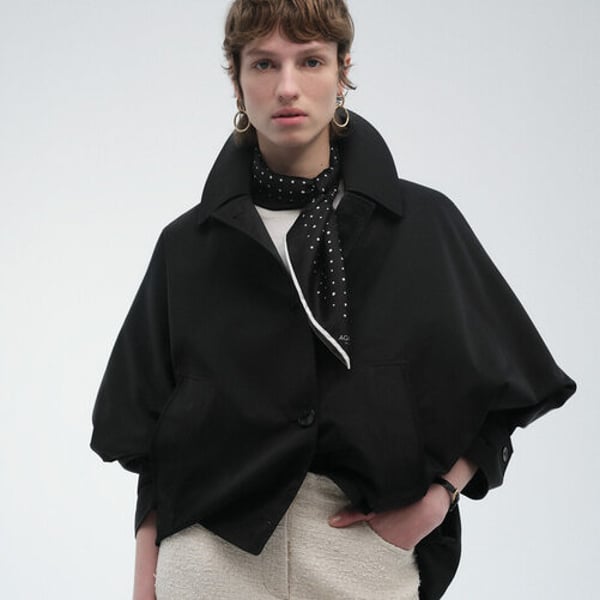
A women’s collection in which lightweight double-faced cashmere coats, capes and bomber jackets with soft, rounded lines are paired with the tactile texture of bouclé. Technical nylons adopt geometric, urban and graphic lines, yielding statement bomber jackets and essential parkas. Ecru, baby blue and peach pink dominate, whilst contrasting piping traces the garments, running across pyjama-style suits and fluid outerwear for softly elegant day looks. Silk cady mini-coats, blazers gently nipped at the waist and flowing suits follow the body with ease. Polka dots appear on diaphanous tops, airy shirts and pleated skirts. Batavia linen in shades of navy, burgundy, pink, and ecru lends a sophisticated nonchalance to tailored pieces, bomber jackets, A-line dresses and shirts. Kaftan dresses and safari shirts in cotton poplin, paired with wide-leg trousers, are embellished with ajouré embroidery.
For menswear, the direction is consistent. Relaxed tailored suits and separates with striped trousers embody the confidence of the contemporary traveller. The Mille Nodi print enlivens light, easy summer shirts, whilst open-weave crochet knits introduce motifs recalling ties long forgotten in drawers, in dialogue with the artisanal textures that run through the collection. Overshirts and leather bomber jackets lend the wardrobe a material richness, evoking a balance between memory and possibility.

Since last spring, Agnona has been running courses in the workshop housed in the brand-new greenhouse on the top floor of its headquarters at Via Archimede 53. “Every month we offer free workshops in textiles and botany, but the greenhouse space also hosts events and is enhanced by a beautiful perimeter terrace (visited by a few cats),” smiles Aimone, recalling how Francesco Ilorini Mo, Agnona’s founder (the company was established in 1953 and hails from Valsesia), was deeply attached to the environment.
The CEO expressed his satisfaction at the sell-out performance of the Milan shop, which opened last April in Via Santo Spirito. “Milan was a lovely surprise,” he confirms, “because although we opened in the run-up to the warm season – which, if you like, is a slightly weaker period for Agnona, historically stronger in winter – the results were significant. And it made us realise that Milan is vibrant even in summer and is increasingly becoming an international metropolis all year round, not only during peak moments (fashion, Design Week…): we saw a truly unexpected influx of international tourists into our shop. Despite the intense heat we had customers from Brazil, China, Kazakhstan… Milan is also a city of art, a little underrated; we should work a bit more in that direction, but we’ll get there in due course.”

Milan was followed by the opening of a shop in Gstaad, the exclusive Alpine resort in Switzerland, in July, within a resort setting. It is a town “linked to a specific, very traditional community, where the authenticity of traditions and the landscape is preserved. It was a wonderful discovery. Again, despite opening in July, halfway through the summer season, Gstaad is a mountain destination with healthy summer footfall. We’re working on openings in the Middle East for 2027,” reveals Aimone.
On the wholesale front, Agnona is carried in hundreds of multi-brand shops worldwide. “We’re investing in the United States and returning to Japan, where we’ve found the right local partner for a market that appreciates our values,” explains Aimone. “We want to invest more in our e-commerce platform, which needs to perform better.”

The brand, sold in 2020 by the Zegna Group to Stefano’s father, the current chairman Roberto Aimone, continues to operate three shops in South Korea, one in Saint-Tropez and a shop-in-shop at Harrods, and closed the 2025 financial year with growth, recording turnover of around 12 million euros. “In 2026 we were flat, following a certain reshuffling of our customer base: we lost some clients, and gained just as many new ones. Our leading market is South Korea, followed by the United States and Germany,” concludes Stefano Aimone, who dismisses any move into categories riding the boom of certain sports, such as skiwear or tenniswear. “Those worlds are not aligned with the brand’s history, which is much more closely linked to nature. We don’t want to be diverted; we want to continue defining our precious identity, which we jealously guard. I believe our customer appreciates that we make choices – we’re not trying to be all things to all people.”
Saman Loira and its nature-inspired stylistic ‘magma’
This marks Saman Loira’s third appearance at Milan Fashion Week, with the addition of the “Tephra Vesuviana” show. The brand was founded five years ago, in 2020, during the pandemic, and is – as the name suggests – highly eclectic, rather like Naples itself. “It draws a little from Persia, a little from the savoir-faire of Neapolitan tailoring (which we are partly losing), a little from France – the Loire, in fact – and it carries multiple meanings, such as home, dignity, hospitality, uniqueness and love, all with positive connotations,” co-founders Francesco Corcione – born in Pompeii and with experience at leading fashion houses – and Francesco Canessa of Naples, part of the creative duo and partners in life, tell FashionNetwork.com. “It’s essentially a declaration of love for France and couture, although nature, and Greek, Roman and Neapolitan mythology are other wells we draw from.”

“In every Saman Loira collection, you’ll always find a nod to nature – moss, a ripple, the earth, water; the elements, in short,” confirms Canessa. “Last year we created the ‘forest dress’; this year, the inspiration was the acorn. From a sustainability perspective, our calling becomes a design challenge, because our concept is to unite two seemingly irreconcilable words: recycling and luxury.”
Francesco Corcione has created a fabric using a mix of offcuts, silk, georgette, chiffon, voile, satin, crêpe satin, jersey and tulle. “There are many hours of work behind it, and the saintly patience required to catalogue everything meticulously by weight, colour, and composition,” says the Saman Loira designer, who elevated the Fashion Week presentation with a collaboration with the Neapolitan chocolatier Gay-Odin, now set to arrive in Milan as well. “If you don’t have a vocation for sustainability, you wouldn’t do this job. It takes passion, and the motivation to make a small contribution to addressing this issue.”

Largely free from seasonal constraints and able to steer their business independently, the two Neapolitan designer–entrepreneurs presented 36 looks on the runway, showcasing a broader range of colours, lengths, structures and outerwear than in previous outings, in a deft blend of a more couture, bespoke, one-of-a-kind attitude with suede and chamois outerwear with a buttery feel, crackled leather trousers and tulle knitwear. “We’ve also added a few pieces for men – a slightly fluid yet very elegant menswear offer,” note the 37-year-old designers. Supported by Camera Moda Fashion Trust, Saman Loira still operates like a bespoke atelier with private clients, but also runs its own atelier and boutique in the heart of Mergellina, Naples’ largest residential district.

Returning to the collection shown at MFW, ‘Tephra’ refers to the magma ejected during the eruption of Vesuvius. “We wanted to signal that the brand is beginning to channel itself in a more defined direction, both commercially and emotionally. Our key stylistic signatures are starting to become recognisable,” conclude Francesco Corcione and Francesco Canessa.
Sara Behbud: Persian motifs, women’s freedom
For the Spring–Summer 2027 season, designer Sara Behbud presents a couture collection that weaves together Persian heritage, women’s freedom and Italian craftsmanship, exploring what it means to inherit a culture and what happens when a woman claims the freedom to choose how to live and interpret it. A collection born of the designer’s Iranian identity and deeply rooted in the spirit of the Woman, Life, Freedom movement, which permeates her narrative. Behbud reflects on a generation of Iranian women who have placed freedom, self-determination and the right to choose at the heart of a global conversation.

At the heart of the collection lies the Afshan motif, one of the floral languages of the Persian carpet tradition. The term ‘Afshan’ evokes the idea of ‘scattering’ or ‘spreading’: flowers, branches and botanical forms seem to disperse freely across the carpet’s surface, creating a continuous pattern without a single dominant centre, reinterpreted through a contemporary, pixelated aesthetic. The motif is deconstructed, enlarged and lifted from the carpet to be placed directly on the female form. After all, the brand’s symbol is the Shah Abbas, another classic and elegant stylised floral design from Persian art.
“I am Persian; I lived in Iran for 23 years. The concept behind the collection stems from Woman, Life, Freedom, because I lived that life; I had problems with the Morality Police, even at university in Tehran, where I was studying fashion, because they monitored the outfits I wore or stopped me because they didn’t consider them appropriate,” says Sara Behbud. “My mother had a fashion house, a boutique, her own brand, and I designed for her, so I grew up surrounded by fabrics and pattern pieces. Unfortunately, Iran isn’t a very open market; my mother couldn’t design certain outfits, because they would then come and shut her shop down. This police force still exists. So I decided to come to Milan, because it’s the city of fashion and I wanted to keep studying and designing freely. My fashion celebrates femininity and the freedom to be oneself, drawing inspiration from Iranian culture and traditional motifs. Perhaps the only thing I can do is be the voice of these women,” explains Behbud.

Sara Behbud’s research into fabrics and techniques is remarkable; she has only been on the Milan Fashion Week calendar since last season. In this SS 2027 collection, the garments are laser-cut, whilst heat-sealed details appear on lace or tulle. Everything is then cut and hand-embroidered onto the dresses. “This is only my second womenswear collection; for now, I’m fulfilling bespoke orders for high-end direct clients, alongside cocktail dresses and even wedding dresses. The fabrics and raw materials are all Italian. Even the silk is 100% Italian. This collection comprises five cocktail looks and four denim looks with a glitter print, all inspired by the Afshan motif,” concludes Sara Behbud.
For Pianegonda, a capsule collection with Pioneer Denim. For Rosato, two openings in Saudi Arabia
Pioneer Denim, a Dhaka-based company in Bangladesh and one of the world’s largest jeans manufacturers, part of the Badsha Group of Industries, presented a new project at the shop of designer jewellery brand Pianegonda, placing its signature material centre stage. The result is a limited-edition capsule: a denim bracelet with a leather heart and silver details, crafted in five different shades of Nîmes blue denim, perfect for joining Pianegonda’s “Assoluto” collection. It offers the two Italian brands a way to convey a universal message of freedom of expression by marrying their unconventional identities with the strength and rebellious spirit of a fabric that, from its very origins, has represented a social revolution and a timeless gesture of emancipation.

“With this capsule we wanted to express a message that is part of the brand’s philosophy and spirit: freedom, the free expression of personality. And there’s a real need for this these days,” Beatrice Beleggia, CEO of the group’s American subsidiary, worldwide brand manager for Pianegonda, and head of public relations for the entire Bros group, tells FashionNetwork.com. “The series of five bracelets will be available exclusively online and at the Pianegonda shop in Milan. But we have some very important wholesalers, and we intend to propose the project to them as well in due course.”
The launch was made even more distinctive by five resin sculptures with silver-toned metallic finishes, created specifically for the project by the Marche artist Sandro Grassetti, known as Sagrasse, which depict major iconographic symbols of 1970s rock culture.
Since 2015, Pianegonda has been part of the Bros Manifatture portfolio in Montegiorgio (FM), a group founded in 1979 by Lanfranco Beleggia, and is considered the holding’s “flagship” (its other brands include Brosway, S’Agapõ, Rosato, Bros, and Dhiva), positioning itself in the high-end contemporary jewellery segment, crafted primarily in 925 silver and gold.

Bros Manifatture now distributes its brands in more than 10,000 multi-brand shops across over 100 countries worldwide. “The latest development is that, with Rosato, we have just entered Saudi Arabia with a major local partner, through whom we will open standalone shops by the end of 2026 – first in Riyadh and then in Jeddah,” reveals Beatrice Beleggia. “But expansion continues for all our brands, particularly in Europe and America,” concludes the Bros Manifatture executive, a group with almost 300 employees.
Rossano: from Quebec City to Italy
The Canadian brand from Quebec City specialising in luxury men’s footwear and accessories – founded by Toby Martineau and manufactured entirely in Italy, near Montegranaro, using leather sourced from Tuscany – chose Milan Fashion Week to present its new lines. “I’m very meticulous with every hide, every part of the shoe I’m making. I started by making shoes for myself, then for a client; that client then spoke to a friend of his, who came to me for another pair. I now have around 20–30 private clients. I design with them and produce with them, so they can see and enjoy what I’m doing,” Toby Martineau tells FashionNetwork.com. He named his brand Rossano in honour of his great-grandfather, who was part French and part Italian. “He was always very exacting about his footwear and his clothing.”

“Now I need shops that understand my vision, that believe in Rossano – in its quality and atmosphere,” adds Martineau. “In Canada it’s different; Canada is like a big-small city, where fast fashion prevails – it’s all very much ‘I need 3,000 units of this’. I don’t produce that way; I’m not that sort of person, because the factory where I make the shoes employs about 12 people – it’s very small – and it buys its leather from an equally small tannery. It’s the 1980s way of making luxury shoes.”

Rossano, which also has a line of trainers, is moving towards expanding its accessories offer. “We already have belts, but we’re looking to produce wallets and travel bags; however, for now I’m focused on boots and shoes. As for me,” he adds, “I make trousers and shirts for myself; perhaps I’ll grow in that direction soon, but for now I’m concentrating solely on footwear. And perhaps from next season, by popular demand, I’ll launch my first women’s styles. I’ve got a lot of work to do,” smiles Martineau.
Copyright © 2026 FashionNetwork.com All rights reserved.